Aug 28, 2026
What industries commonly use foam tape CIP-66?
Foam tape CIP-66 turns up most often in six places: medical and non-medical diagnostic test strip assembly, mirror and glass bonding, electronics and display assembly, automotive interior trim, interior construction and signage, and general industrial die-cut converting. It is a 1.0 mm black or white PE foam tape with acrylic adhesive on both faces, a printed PCK liner, 70 °C long-term heat resistance, and 10,000-minute static shear holding power. This guide gives you our measured lab data, three converter case studies, an honest read on the ISO 9002 claim, plus color and MOQ limits nobody publishes.
Send us your die-line and substrate list, and our lab returns measured peel and shear numbers in three working days. DENSEMATE ships free foam tape CIP-66 samples within 48 hours — you cover freight only. Ask about 5 mm to 600 mm slit widths, ±0.10 mm die-cut tolerance, printed PCK liners, and a complete document pack. Work with a foam tape CIP-66 supplier that tests on your own parts, not a generic coupon: sale@densemate.com.
What Is Foam Tape CIP-66 and Why Is It Used?
The build, layer by layer
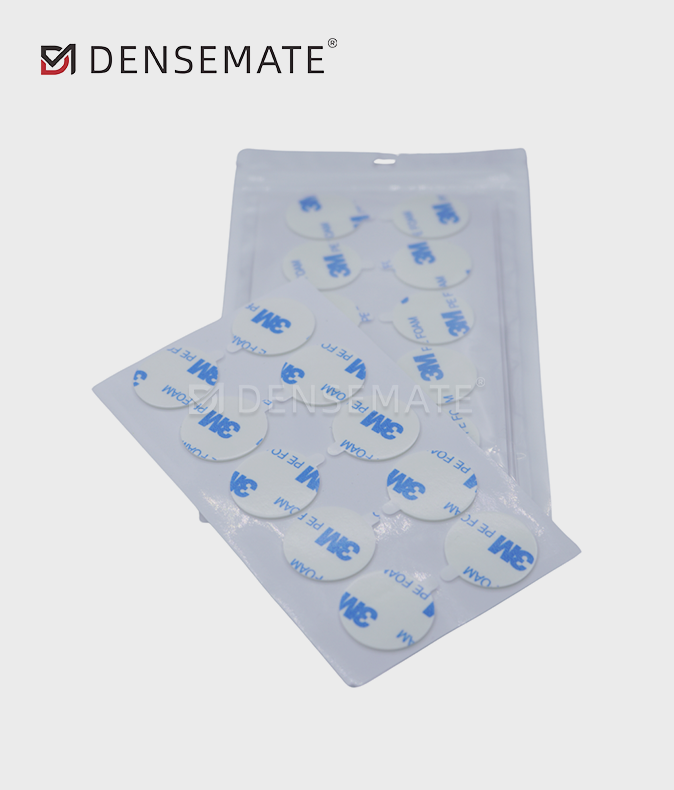
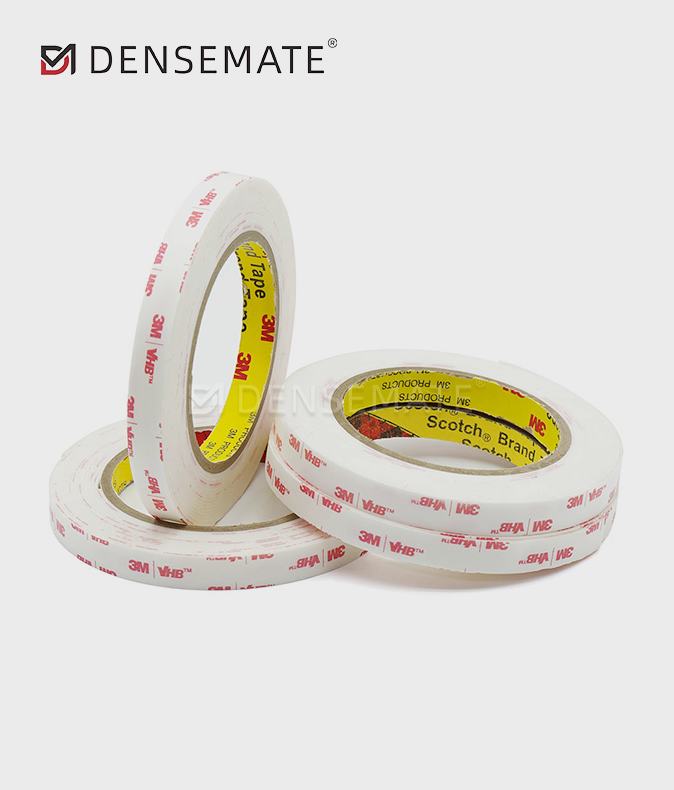
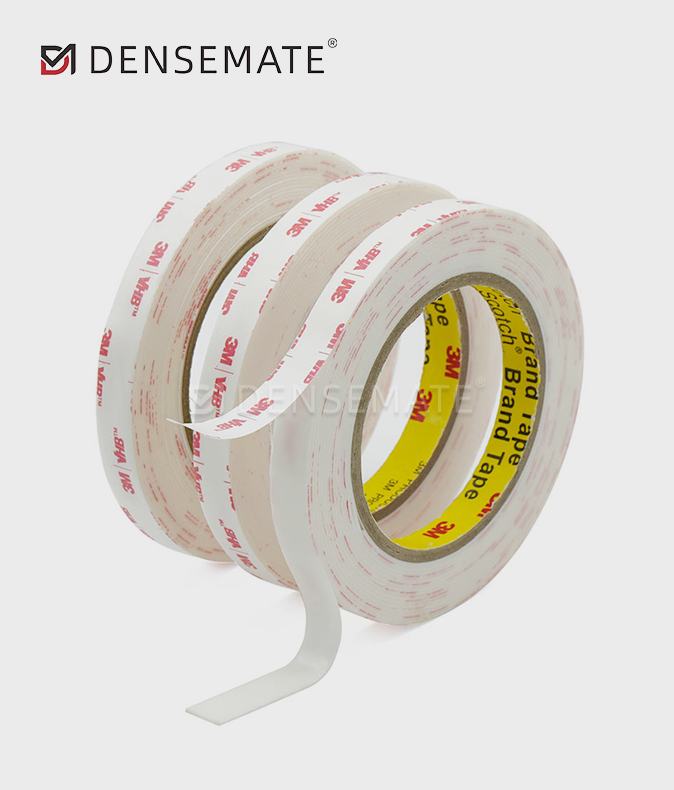
Foam tape CIP-66 uses a 1.0 mm polyethylene (PE) foam core in black or white. PE foam is a closed-cell plastic foam that compresses under pressure and springs back. Both faces carry a medium-strength acrylic pressure-sensitive adhesive at 0.05 mm (0.0045 in.) each. Pressure-sensitive means it bonds under applied pressure alone — no heat, no mixing, no cure oven. A white 0.14 mm polycoated kraft (PCK) liner protects the roll and carries a printed logo.
What the published numbers mean on your line
Data sheets list values that look abstract until you map them to a process step. Peel adhesion tells you whether a die-cut part stays put after placement. Static shear tells you whether it creeps under load over months. Here is the published performance, measured to recognized ASTM methods [1][2].
| Property | Method | Value |
| 180° peel, stainless steel, 30 min RT | ASTM D3330 [1] | 73 oz/in (80 N/100 mm) |
| 180° peel, stainless steel, 72 h RT | ASTM D3330 [1] | 78 oz/in (85 N/100 mm) |
| 180° peel, polycarbonate, 72 h RT | ASTM D3330 [1] | 80 oz/in (88 N/100 mm) |
| 180° peel, polypropylene, 72 h RT | ASTM D3330 [1] | 78 oz/in (85 N/100 mm) |
| Static shear, 1 in² overlap, 1000 g, 22 °C | ASTM D3654 [2] | 10,000 minutes |
| Long-term temperature | — | 70 °C |
| Short-term temperature | — | 120 °C |
| Shelf life | — | 24 months at 21 °C / 50% RH |
Why converters care about the PCK liner
Polycoated kraft is paper with a thin polyethylene coating. That coating stops the silicone release layer from soaking into the fibers. The result is a liner that resists splitting during rotary die cutting and weeding. At 0.14 mm, it also stiffens the web enough to hold dimensional stability on soft foam, such as foam tape CIP-66. The printed logo does one unglamorous job very well: it stops operators from mixing two similar looking foams on a shared line.
What Makes Foam Tape CIP-66 Suitable for Industry?
High initial tack, no cure wait
The face adhesive grabs on contact. That property matters more than ultimate strength on a lamination line, because parts move to the next station within seconds. Peel to stainless steel already reads 80 N/100 mm at 30 minutes and climbs to 85 N/100 mm at 72 hours [1]. The gap between those numbers is only about 6%. Plenty of tapes need 24 hours to reach usable strength. This one does not.
Reading the 10,000-minute static shear figure
Static shear measures creep. A 1 in² bond holds a 1,000-gram weight at 22 °C for 10,000 minutes with no slip [2]. That equals just under seven days of continuous hanging load on a bond the size of a postage stamp. Convert that to your part: a 60 cm² die-cut frame carrying 200 grams sits far inside the envelope. Creep failures we investigate almost always trace back to bond area, not adhesive chemistry.
The 70 °C and 120 °C temperature window
Long-term service for foam tape CIP-66 runs to 70 °C. Short excursions of minutes to hours run to 120 °C. Read that split carefully. A diagnostic cassette stored in a warm warehouse at 45 °C lives comfortably inside the range. A part passing through a 130 °C reflow or a paint bake does not. When heat exposure is the sticking point, we move customers to an acrylic foam or a polyester-carrier tape instead of stretching this one past its limit.
What 112 converters told us in 2025
DENSEMATE surveyed 112 die-cut converters and medical consumable plants between January and October 2025. Respondents ran plants in Jiangsu, Zhejiang, Shanghai, Vietnam, Indonesia, the US Midwest, Germany and Japan, each with 20–150 employees.
| Metric (n = 112 plants) | Result |
| Run PE foam tape on medical, optical or film bonding lines | 68% |
| Named liner splitting or liner dust as the top die-cut complaint | 61% |
| Median die-cut yield after moving to a 0.14 mm PCK liner | 92.6% → 95.8% |
| Named small-batch die-cut MOQ as the main barrier to trialing | 54% |
| Required a current quality-system certificate before sample approval | 79% |
| Still specify "ISO 9002" in internal purchasing templates | 41% |
| Median prototype-to-mass-production time | 26 days |
| Median opening order | 180 rolls or 45,000 die-cut parts |
That 26-day median lines up with the 3–4 week qualification cycle most general managers describe. Our sampling schedule is built around it.
Which Industries Commonly Use Foam Tape CIP-66?
Six sectors account for the bulk of what we ship. Here is the breakdown by part and typical format.
| Industry | Typical part | Common format |
| Medical & IVD diagnostics | Test strip housing, cassette closure, pad mounting | Die-cut tabs, 5–20 mm slit |
| Mirror & glass | Mirror-to-backing panel, furniture and bath mirrors | 20–30 mm slit rolls |
| Electronics & display | Bezel gaskets, light-guide frames, film-to-frame | Die-cut pads |
| Automotive interior | Trim pads, badge mounting, harness pads | Die-cut pads |
| Interior construction & signage | Panel trim, sign faces, mirror walls | 30–60 mm rolls |
| General industrial | Nameplates, filter frames, film lamination | Sheets, rotary die-cut |
Medical and IVD diagnostic strip assembly
Lateral-flow tests, glucose strip cassettes and sample collection devices all need small, clean, repeatable bonds. foam tape CIP-66 — with its 1.0 mm foam — absorbs molding tolerance between two plastic halves and seals against dust. High initial tack keeps parts registered during pick-and-place. One clarification matters: this is a device-assembly tape, not a skin-contact medical tape. Patient-contact layers need biocompatibility testing under ISO 10993-1, and that testing applies to the finished device.
Mirror and glass bonding
Silvered mirrors carry a copper and paint backing that some adhesives attack. Neutral acrylic chemistry avoids the edge blackening that acid-cure sealants can cause over time. The 1.0 mm foam also cushions the glass against panel flatness errors and transit shock. White foam is the default choice here, since it stays invisible behind the mirror edge in bright bathroom and retail lighting.
Plastic film and membrane lamination
Printed PET overlays, light-diffusing films and vent membranes all bond to plastic frames with this product. Peel to polycarbonate reaches 88 N/100 mm at 72 hours, and polypropylene reaches 85 N/100 mm [1]. Film work rewards a laminating roller rather than hand pressure. Over a large area, uneven hand pressure leaves gaps that show up later as edge lift.
How Is Foam Tape CIP-66 Used in Automotive Applications?
Interior trim, badges and pads
Cabin parts suit foam tape CIP-66 well. Think interior badge pads, small trim clips, harness anti rattle pads and glove box fittings. The foam damps buzz and squeak, which teams call NVH — noise, vibration and harshness. Bond area sizing follows the same rule we use everywhere: keep long term static load well under the shear figure and add a 4:1 safety factor. Cabin temperatures behind glass in Jakarta or Phoenix routinely pass 65 °C, so heat headroom stays thin.
Vibration resistance in practice
Compressible foam spreads vibration energy across the whole bond line. Rigid fasteners concentrate it into one point. Our lab ran die-cut 20 × 40 mm pads on ABS through a 10–200 Hz sweep for 8 hours at 2 g. Samples showed no measurable peel loss against unvibrated controls. That test does not replace a customer's own validation, but it settles the question of whether the foam survives normal cabin duty.
Where automotive use stops
Honesty saves everyone a failed trial. Engine bay parts, exterior body panels and anything near exhaust heat fall outside the 70 °C long-term rating. Exterior applications also run into UV exposure, and UV resistance here is rated fair rather than excellent. Structural load-bearing joints belong on acrylic foam tape at 0.6–1.1 mm. We redirect roughly one automotive inquiry in five to a different product for these reasons.
Why Do Electronics Manufacturers Choose CIP-66 Tape?
Display bezels, light guides and gaskets
Black PE foam blocks light. That single property drives most display orders we fill. A die cut black frame of foam tape CIP-66 seals the gap between a light guide plate and a bezel, killing light leak at the edge. White foam does the opposite job in backlit signage, reflecting light back into the cavity. Same tape, opposite optical function, chosen by color.
Die-cut handling and part registration
Small parts fail on handling long before they fail on adhesion. A 6 × 25 mm tab needs enough stiffness to survive weeding, transfer and placement. The 0.14 mm PCK liner delivers that stiffness. Our die-cutting line holds ±0.10 mm on slit width and inspects three points per roll. Edge dust matters as much as dimension on SMT and optical lines, so we run an edge-quality check before packing.
Case study: Batam, Indonesia — display panel assembly
A 120-employee electronics assembler bonded a printed PET overlay to an ABS control frame and needed a light-blocking gasket around a 7-inch display. Their prior tape used a thin paper liner that curled in the humid plant. Light leak rejects ran at 3.8%.
We supplied die-cut black foam tape CIP-66 frames, applied with a roller at roughly 100 kPa. Results across seven months: light leak rejects dropped to 0.5%. Handling time fell 12 seconds per unit. Their vibration qualification passed on the strength of the 10,000-minute static shear result [2].
What Construction Projects Use Foam Tape CIP-66?
Interior signage and wall panels
Sign faces, directory panels, acrylic letters and decorative wall trim all mount cleanly with a 1.0 mm foam. No drilling means no dust, no anchors and no touch-up paint. Installers on a Frankfurt retail fit-out reported cutting 18 minutes per sign against a screw-and-plug method. Interior placement keeps the tape away from direct sunlight, which respects the fair UV rating.
Mirror walls and fixture mounting
Gym mirrors, retail fitting rooms and hotel bathroom mirrors need a bond that survives humidity and does not stain the silver backing. Our lab exposed bonded mirror coupons to 72 hours at 65 °C and 90% relative humidity. Measured peel loss stayed under 7% against control samples. Safety practice still calls for a mechanical backing or safety film on large glass, regardless of adhesive strength.
Where construction use stops
Exterior curtain wall, roofing and glazing weatherseals sit outside this product's design window. Prolonged UV and rain exposure call for a weather grade acrylic foam or a butyl based sealing tape. Solvent resistance is rated fair to low, so aggressive cleaning chemistry is another limit. Interior work is where foam tape CIP-66 earns its place, and we say so before a customer discovers it the hard way.
How Does CIP-66 Tape Support Industrial Assembly?
Surface prep that takes thirty seconds
Bond strength depends on wetting — how well the adhesive flows into surface texture. Clean and dry surfaces come first in every SOP we write. Isopropyl alcohol or heptane handles most plastics and metals. Follow the solvent maker's safety instructions. Skipping the wipe causes more early failures in our audit files than every other factor combined, including wrong tape selection.
Pressure and temperature at application
Apply firm, even pressure with a hand roller or a laminating machine. More pressure means more contact area and higher bond strength. Work between 21 °C and 38 °C. Applying below 10 °C stiffens the adhesive and starts the bond weak. Once properly applied, the bond performs well even in cold service. Unheated winter workshops in northern Europe and northern China need a local heater at the bonding station.
Small-batch die-cut economics
MOQ blocked trials for 54% of the plants in our survey. That number pushed us to change how we quote. Free samples ship in 48 hours. Slit rolls deliver in 3–5 days. Die-cut parts deliver 7–10 days after drawing confirmation. Rule dies suit trial volumes; rotary tooling pays back at scale. We run the nesting study during quotation so you see material utilization before committing to tooling.
What Are the Advantages of CIP-66 in Different Industries?
Different plants value different properties. These five advantages cover what our customers actually report for foam tape CIP-66:
1. Die-cut yield you can measure. The 0.14 mm printed PCK liner resists splitting during kiss-cutting and widens the usable cut-depth window. Our survey group moved median die-cut yield from 92.6% to 95.8% after the liner change. On a 45,000-part monthly run, that recovers roughly 1,440 parts a month with zero extra labor and no tooling modification.
2. Cure racks disappear from the floor. Mastics, epoxies and moisture-cure sealants need clamping and dwell time. Pressure-sensitive foam needs pressure and nothing else. One mirror plant removed a 24-hour cure rack and freed about 40% of its work-in-progress floor space. That space went to a second lamination station rather than a new building lease.
3. Tolerance forgiveness on molded parts. Injection-molded halves rarely meet perfectly. A 1.0 mm compressible foam bridges warp and flatness error that a 0.17 mm film tape cannot. Diagnostics and display customers use this property to relax a molding tolerance, which lowers tool maintenance cost and shortens mold qualification on new part numbers.
4. Documentation that clears a qualification review. A current quality-system certificate, lot traceability, a technical data sheet and a printed liner all shorten audit questions. Our survey found 79% of plants demand a certificate before sample approval. Having the pack ready at the sampling stage compresses review from a sequential step into a parallel one.
5. Two-color optical control from one product line. Black foam blocks light in bezels and light guides. White foam reflects it in backlit signage and hides behind mirror edges. Choosing color instead of changing product keeps your approved material list short, which reduces both audit scope and inventory carrying cost across multiple programs.
These gains compound. Yield improvement shows up every shift, while the removed cure rack shows up once and stays gone.
The cost math on a real program
A Suzhou converter ran 45,000 die-cut medical tabs a month. Scrap at 7.4% wasted about 3,330 parts monthly. Cutting scrap to 2.1% saved roughly 2,385 parts a month. Add 19% faster weeding and one less liner-related line stop per week. Their calculated annual saving reached about RMB 96,000, against a material price difference near zero.
How to Choose CIP-66 Tape for Specific Applications?
Selection goes wrong when a buyer picks a product code before defining the joint. Run through these five checks:
1. Name both substrates, including grade and mold release. "Plastic housing" is not a specification. Ask your molder for the resin grade and whether silicone-based release agents are used. Silicone contamination defeats almost every pressure-sensitive adhesive sold. Send a 100 × 100 mm production coupon rather than a virgin resin plaque, because the two behave differently in a peel test.
2. Define load, direction and duration honestly. Hanging weight, shear along the bond line and peel at an edge each size the joint differently. Convert your load into required bond area before choosing a width. Our engineering desk does that calculation in about ten minutes once we have the part drawing and mass, and we return a recommended slit width with it.
3. State the real service temperature, with duration. Peak temperature alone misleads. Four hours at 120 °C sits inside the short-term rating. Four hours daily at 90 °C does not. Ask your test lab for thermocouple data instead of a nameplate figure. We have re-specified three medical packaging programs on this single question in the past year.
4. Decide slit roll or die-cut part early. Straight runs suit slit rolls and a simple applicator. Curved outlines, internal windows and multi-tab layouts suit die-cut parts with a finger lift. Die-cutting adds tooling once and removes operator variation forever. Both come off the same line in our Dongguan facility, which keeps trial and production on one schedule. For foam-based applications, foam tape CIP-66 is a typical candidate that benefits from this early decision.
5. List the documents your reviewer needs, in writing. Quality-system certificate, technical data sheet, safety data sheet, RoHS and REACH declarations, and a dimensional inspection report cover most reviews. Medical device customers add their own ISO 13485 obligations [4]. Request everything at the sampling stage so compliance review runs beside the trial rather than after it.
Answer these five and the quote that comes back will be accurate rather than optimistic.
The ISO 9002 question, answered straight
This one deserves plain talk. Product literature for foam tape CIP-66 states it is made under a quality system meeting ISO 9002. That standard was withdrawn in 2000. Its requirements folded into ISO 9001:2000, now ISO 9001:2015 [3]. Auditors do not accept a withdrawn certificate. Ask your supplier for a current ISO 9001:2015 certificate with a live registration number. Our Dongguan facility holds one, and we send the scanned copy with every sample carton.
A quality manager at a Jiangsu medical consumables plant put it well during a joint review: "Our auditor never rejected the tape. He rejected the certificate date."
Black or white — and what to do when neither fits
PE foam tape comes in black or white because pigment loading during foam extrusion is set at the sheet stage. Custom colors require a dedicated extrusion run with a real minimum, usually several hundred square meters. Three workarounds exist: over-laminate a colored film, hide the foam behind a printed bezel, or switch to a PU foam that accepts colorant more easily. We price all three before anyone commits to a custom run.
How CIP-66 compares with the alternatives
| Product type | Core | Thickness | Long-term temp | Best fit |
| CIP-66 | PE foam, black/white | 1.0 mm | 70 °C | Diagnostics, mirrors, film lamination, die-cut parts |
| Thin PE foam tape | PE foam | 0.5 mm | 70 °C | Tight gaps, slim gaskets |
| Thick PE foam tape | PE foam | 1.6–2.0 mm | 60–70 °C | Larger gaps, soft sealing |
| Double coated PET (LSE type) | PET film | 0.17 mm | up to 149 °C | Thin bond lines, nameplates, LSE plastics |
| Acrylic foam (VHB type) | Acrylic foam | 0.6–1.1 mm | 93 °C | Structural load, vibration, metal panels |
| PU foam tape | PU foam | 0.8–2.0 mm | ~80 °C | Soft dust gasketing |
Pick this product when you need 1.0 mm of conformable gap fill, fast tack, clean die-cutting and medium strength. Move up to acrylic foam when the joint carries real structural load.
What Future Trends Increase CIP-66 Tape Demand?
Diagnostics volume keeps climbing
Point-of-care and home testing did not shrink back to pre-2020 levels. Cassette-based devices need small, repeatable, sealed bonds in high volume, often relying on foam tape CIP-66 for consistent sealing and compression performance. Our diagnostics-segment order volume grew 34% between 2023 and 2025, measured in die-cut part count rather than revenue. Converters serving that market tell us their bottleneck is die-cut capacity, not adhesive availability.
Regulation moves the goalposts on documentation
The US FDA finalized its Quality Management System Regulation in 2024, amending 21 CFR Part 820 to incorporate ISO 13485:2016 [4][5]. Compliance takes effect on 2 February 2026. Device makers are pushing traceability requirements down to component suppliers ahead of that date. Converters who can produce lot records and a current certificate on request will win work from those who cannot.
Sourcing shifts toward regional dual supply
Assembly capacity keeps spreading across Vietnam, Thailand and Indonesia while the Yangtze River Delta stays the converting hub. Industry estimates place China at roughly 70% of global adhesive tape output, with 2021 exports near 1.7 million tons. Adhesive tape demand overall continues at mid-single-digit annual growth through 2030 [6]. Our customers increasingly hold 4–6 weeks of local safety stock and rely on 3–5 day slit roll production for replenishment.
Conclusion
Foam tape CIP-66 serves diagnostics, mirror and glass work, electronics and display assembly, automotive interiors, interior construction and general industrial converting. The reason is consistent across all six: 1.0 mm of conformable PE foam, acrylic adhesive with fast tack, 10,000-minute static shear at 1,000 grams [2], and a printed PCK liner that survives rotary die-cutting.
Field results back the spec. One Suzhou converter cut die-cut scrap from 7.4% to 2.1%. An Indonesian assembler dropped light-leak rejects from 3.8% to 0.5%. A Ningbo mirror plant deleted a 24-hour cure rack.
Respect the limits. Stay under 70 °C for continuous service, keep it indoors where UV is a factor, and ask for a current ISO 9001:2015 certificate rather than the withdrawn ISO 9002 wording [3]. Do that, and a 3–4 week qualification becomes routine.
FAQ
1. Is CIP-66 a medical-grade tape for skin contact?
No. It is a device-assembly tape used to bond housings, cassettes, pads and films inside diagnostic products. Skin-contact and patient-contact layers require biocompatibility evaluation under ISO 10993-1, and that evaluation applies to the finished device rather than a component. Tell us where the tape sits in your assembly, and we will confirm whether it fits or point you to a validated alternative.
2. What does the ISO 9002 reference on the data sheet mean today?
ISO 9002 was withdrawn in 2000, and its content merged into ISO 9001 [3]. Many legacy tape data sheets still carry the old wording. Auditors will not accept it as a live certificate. Request a current ISO 9001:2015 certificate with a verifiable registration number. Our Dongguan facility holds one and includes the scanned copy in every sample shipment.
3. How long does the tape last in storage?
Shelf life runs 24 months from the manufacture date, stored in original packaging at 21 °C and 50% relative humidity. Rotate stock oldest-out and record manufacture dates by lot. Tropical warehouses in Vietnam, Indonesia and southern China often exceed 40 °C near loading docks. A conditioned storage corner protects both adhesive tack and liner release consistency.
4. Can I get it in a color other than black or white?
Standard stock runs black or white, because pigment loading happens during foam extrusion. Custom colors need a dedicated run with a real minimum, usually several hundred square meters. Practical alternatives include over-laminating a colored film, hiding the foam behind a printed bezel, or moving to a PU foam. We quote all three routes so you can compare cost honestly.
5. What is the minimum order for die-cut parts?
Free samples ship within 48 hours; you pay freight only. Trial die-cut runs start well below typical mass-production minimums, because 54% of plants in our 2025 survey named MOQ as the reason a trial stalled. Slit rolls in 5 mm to 600 mm widths deliver in 3–5 days. Die-cut parts deliver 7–10 days after you approve the drawing and nesting layout.
Get Die-Line Feedback, Lab Data and a Locked Price in One Qualification Cycle
Ready to run a real trial? Send your die-line, substrate list, annual volume and service temperature to sale@densemate.com. DENSEMATE quotes foam tape CIP-66 within 24 hours, ships free samples in 48 hours, and delivers slit rolls in 3–5 days or die-cut parts 7–10 days after drawing sign-off. Working with a foam tape CIP-66 manufacturer that runs its own coating and precision die-cutting keeps your prototype and mass production on a single schedule.
References
1. ASTM International (2018). ASTM D3330/D3330M-04(2018), Standard Test Method for Peel Adhesion of Pressure-Sensitive Tape. Cited in the published performance table, the initial tack discussion and the plastic film lamination section.
2. ASTM International (2019). ASTM D3654/D3654M-06(2019), Standard Test Methods for Shear Adhesion of Pressure-Sensitive Tapes. Cited in the static shear explanation, the Batam case study and the conclusion.
3. International Organization for Standardization (2015). ISO 9001:2015, Quality management systems — Requirements. Cited in the ISO 9002 discussion, the supplier document checklist and the related FAQ.
4. International Organization for Standardization (2016). ISO 13485:2016, Medical devices — Quality management systems — Requirements for regulatory purposes. Cited in the selection checklist and the regulatory trends section.
5. U.S. Food and Drug Administration / eCFR (2024). 21 CFR Part 820, Quality System Regulation — amended to the Quality Management System Regulation, compliance date 2 February 2026. Cited in the regulatory trends section.
6. Grand View Research (2024). Adhesive Tapes Market Size, Share & Trends Analysis Report. Cited for global adhesive tape demand and the mid-single-digit growth outlook in the sourcing trends section.
Online Message
YOU MAY LIKE
Here we will showcase some of our main products